My Approach

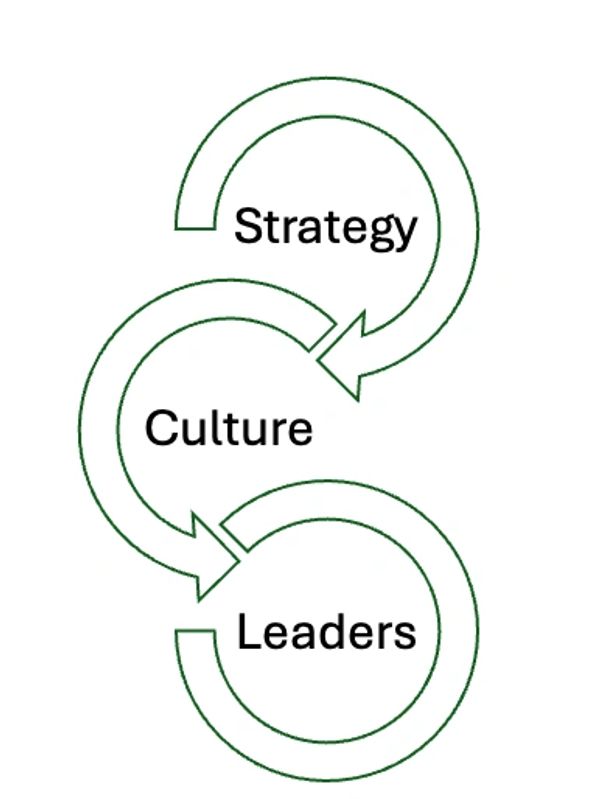
Strategy, Culture, and Leaders
Strategy provides the necessary direction, defines objectives, and outlines the plans and actions required to achieve organizational goals. It is methodical, analytical, and focuses on resource allocation, market positioning, and measurable outcomes.
The organization’s culture can either support or undermine strategic goals. Ideally, culture and strategy should complement and reinforce each other. When properly aligned, they become powerful enablers for sustainable business growth.
For instance, a culture emphasizing continuous improvement and innovation aligns naturally with a strategy that seeks market leadership through innovation-driven products or services. Employees will readily embrace change and proactively seek out creative solutions, thereby effectively supporting the strategic direction.
Alternatively, if a culture promotes risk aversion and a preference for maintaining the status quo, attempts to pursue ambitious, disruptive strategies will face significant resistance, potentially derailing the organization's broader goals.
In essence, understanding your organization's culture is crucial for formulating achievable strategies. Culture acts as a landscape, influencing how strategies are executed and determining their feasibility and effectiveness. Like the terrain affects travel ease, organizational culture influences the ease of strategic execution.
Leadership is crucial for harmonizing culture and strategy. Leaders who actively embody and promote desired cultural values set the stage for strategic alignment. By consistently demonstrating commitment, transparency, empathy, and accountability, leaders build a robust organizational culture that supports strategic objectives.
Assessment
The starting point is the strategy leadership is endeavoring to execute. In some instances, it’s market and customer driven. In other instances, it’s operational, from improved quality or production efficiency to mitigating ethics and compliance risks.
My work starts when there are challenges in execution. And I start asking “why?”
Senior leaders agree that alignment of strategy, people, culture, processes and systems is essential to high performance.
Where is the misalignment? Collaboration breaking down? Lack of trust? Resistance to change? These are aspects of a dysfunctional culture. And what are leaders doing or not doing to perpetuate the dysfunction?
I use qualitative and quantitative analytics to provide leaders with an objective picture of the current state.

Action
The road to alignment starts with leaders. However, when business experts speak of what leaders need to do to align culture and strategy they often ignore foundational human foibles that can hold us back.
Drawing on research by Amy Edmondson (psychological safety), Daniel Kahneman (decision-making under uncertainty), and Max Bazerman (behavioral ethics), I deploy a methodology that blends evidence-based insights with practical tools for leaders.
My focus is on working with leaders and teams that may struggle with confidence or courage in high-stakes situations. Through one-on-one coaching, team labs, and tailored assessments, I help leaders, leadership teams, and as a result, their organizations.

Barrett Analytics
I have used Barrett Analytics in my work for over 25 years. They are widely recognized for their ease of use, detailed diagnostics, and meaningful insight. They are based on proven methodology and perfected over more than 30 years of real-world experience, used by thousands of organizations and leaders around the world.